

Request a live demo
Want to see what else data clean rooms can do? Have a specific use case in mind? Let us show you.

Commerce media will grow 12.1% this year, according to the IAB’s 2026 Outlook Study, making it the fastest-growing digital channel. The category runs almost entirely on first-party data, clean rooms, and CRM onboarding. But many teams find their customer data platform (CDP) handles internal orchestration well while falling short on external activation or collaboration.
This guide covers the alternatives worth evaluating when the gap is less "which CDP should I pick?" and more "do I need a different category of tool entirely?"
CDP alternatives at a glance
Sometimes the answer is a better customer data platform, not a different category. If the issue is the wrong vendor, platforms like Segment, Tealium, and Salesforce Data Cloud compete in this space. Gartner Peer Insights.
The three categories below are for teams whose gap goes beyond what any traditional CDP can solve. Some carry the CDP label but take a fundamentally different approach to data architecture. With third-party data in accelerating decline, all three are increasingly relevant.
What a customer data platform does
Before evaluating alternatives, it is worth being clear about what CDPs are designed to do. A customer data platform remains the right tool when the primary need is:
- Unifying internal first-party data from CRM, website, app, email, and point-of-sale into a single customer profile.
- Identity resolution across owned channels, unifying known customer identifiers — such as email hashes and loyalty IDs — to maintain a consistent view of the customer journey across your internal ecosystem.
- Audience segmentation for owned-channel activation, such as email campaigns, on-site personalization, and loyalty programs.
- Single customer view for reporting, giving marketing and analytics teams one place to understand customer behavior across touchpoints.
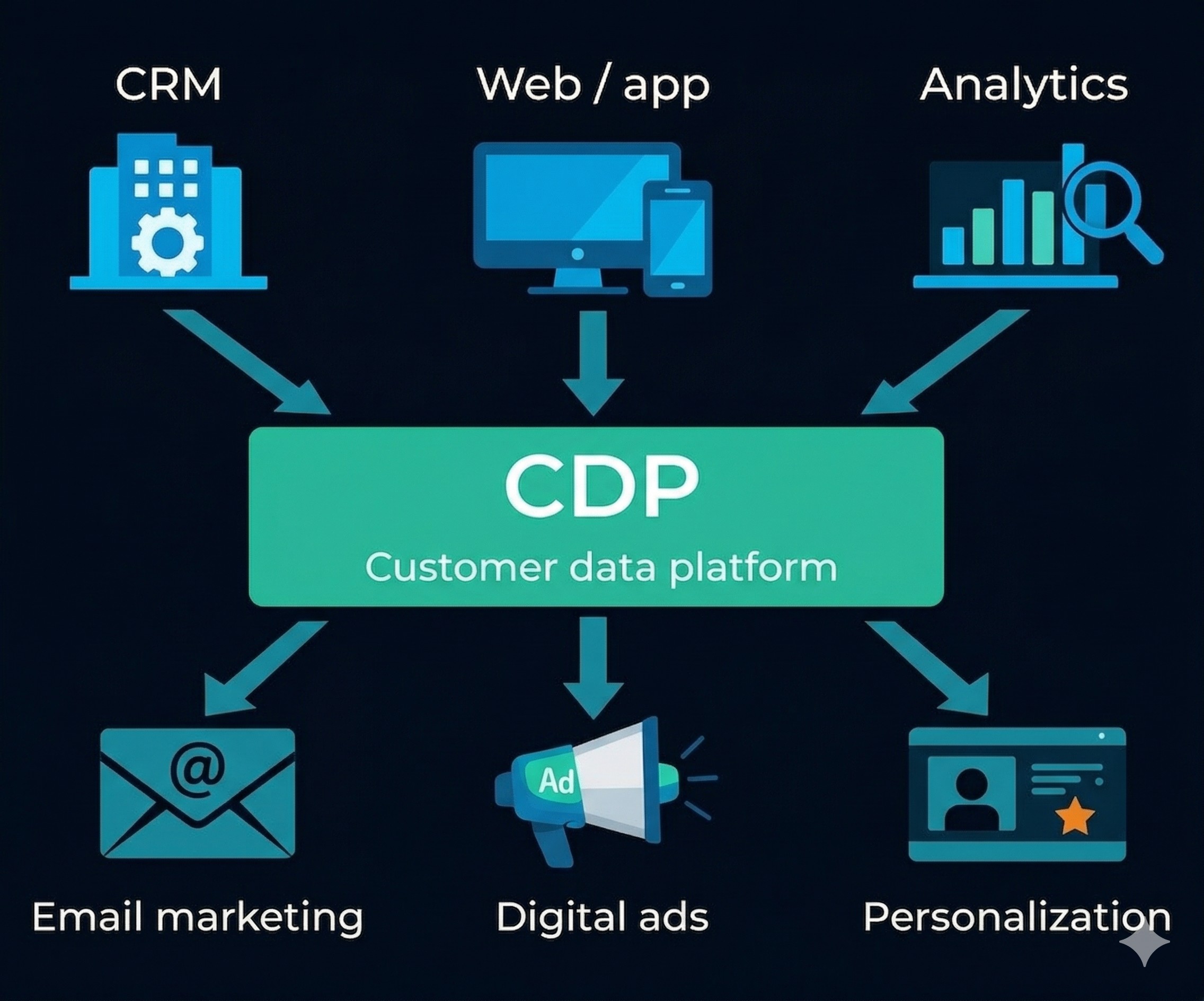
These are valuable capabilities. The alternatives below do not replace them. They address the use cases that fall outside the CDP's original design: warehouse-native activation, cross-party collaboration, and privacy-preserving media delivery with external partners.
The Two Faces of the CDP
In 2026, the market has effectively split into two directions: Martech CDPs (like Adobe, Hightouch, or Zeotap) which focus on internal lifecycle orchestration, and Adtech CDPs — increasingly referred to as Collaborative Audience Platforms (like Decentriq, Mediarithmics, or Permutive) — which are built specifically for the privacy-first advertising ecosystem.
CDP alternatives for data activation and collaboration
Each category below solves a different problem. Composable CDPs address internal architecture. Data clean rooms address cross-party analysis. A Collaborative Audience Platform addresses privacy‑safe, end‑to‑end audience building and activation.
Composable CDPs and reverse ETL
Composable CDPs are not traditional customer data platforms with a new name. If your data already lives in a cloud warehouse like Snowflake, BigQuery, or Databricks, there is no reason to copy it into a separate platform. These tools sit on top of the warehouse instead.
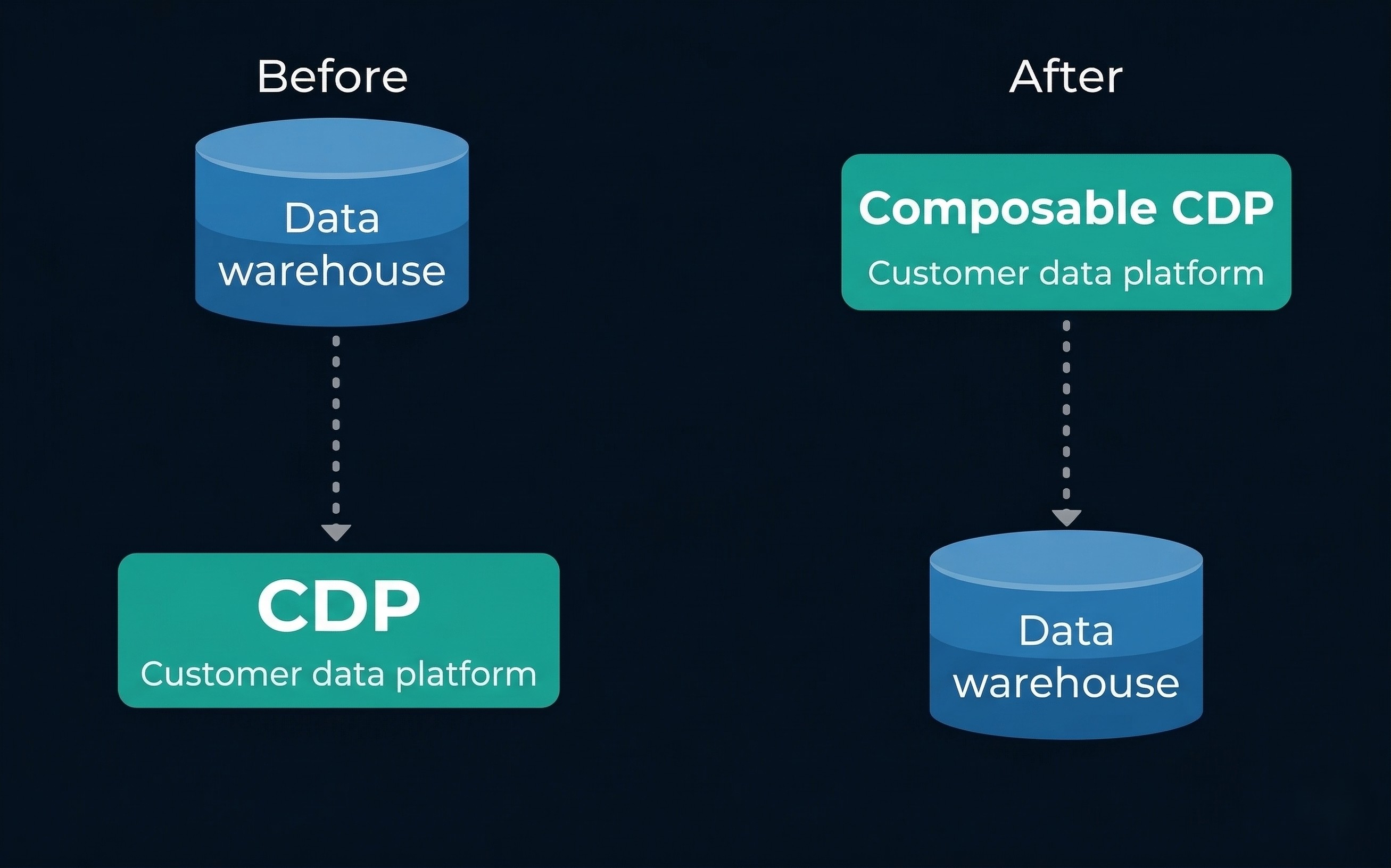
They provide the segmentation, activation, and sync capabilities that traditional CDPs bundle into their own storage layer. Reverse ETL (syncing data from a warehouse back out to operational tools) is the underlying mechanism.
Key players: Hightouch, Census, RudderStack
What they solve: The duplication problem. Traditional CDPs ingest data into their own environment, creating a second copy that drifts from the warehouse over time. Composable CDPs eliminate that copy, treating the warehouse as the single source of truth and syncing audiences to downstream tools.
How they differ from traditional CDPs: No proprietary data store and no separate identity resolution layer in most cases. The warehouse does the heavy lifting; the composable CDP handles segmentation and activation. The data team retains full control over modeling, governance, and access.
Best for: Data-mature teams already invested in a cloud warehouse with engineering resources to maintain it. Less suited to teams without an established data infrastructure or those who need built-in ingestion and identity stitching.
Limitations:
- Does not address external data collaboration. Composable CDPs activate your own data through your own channels.
- Requires a well-modeled warehouse. If the underlying data is messy or incomplete, the composable CDP inherits those problems.
- Engineering dependency is higher than a traditional CDP. Marketing teams rarely self-serve without data team support.
Data clean room providers
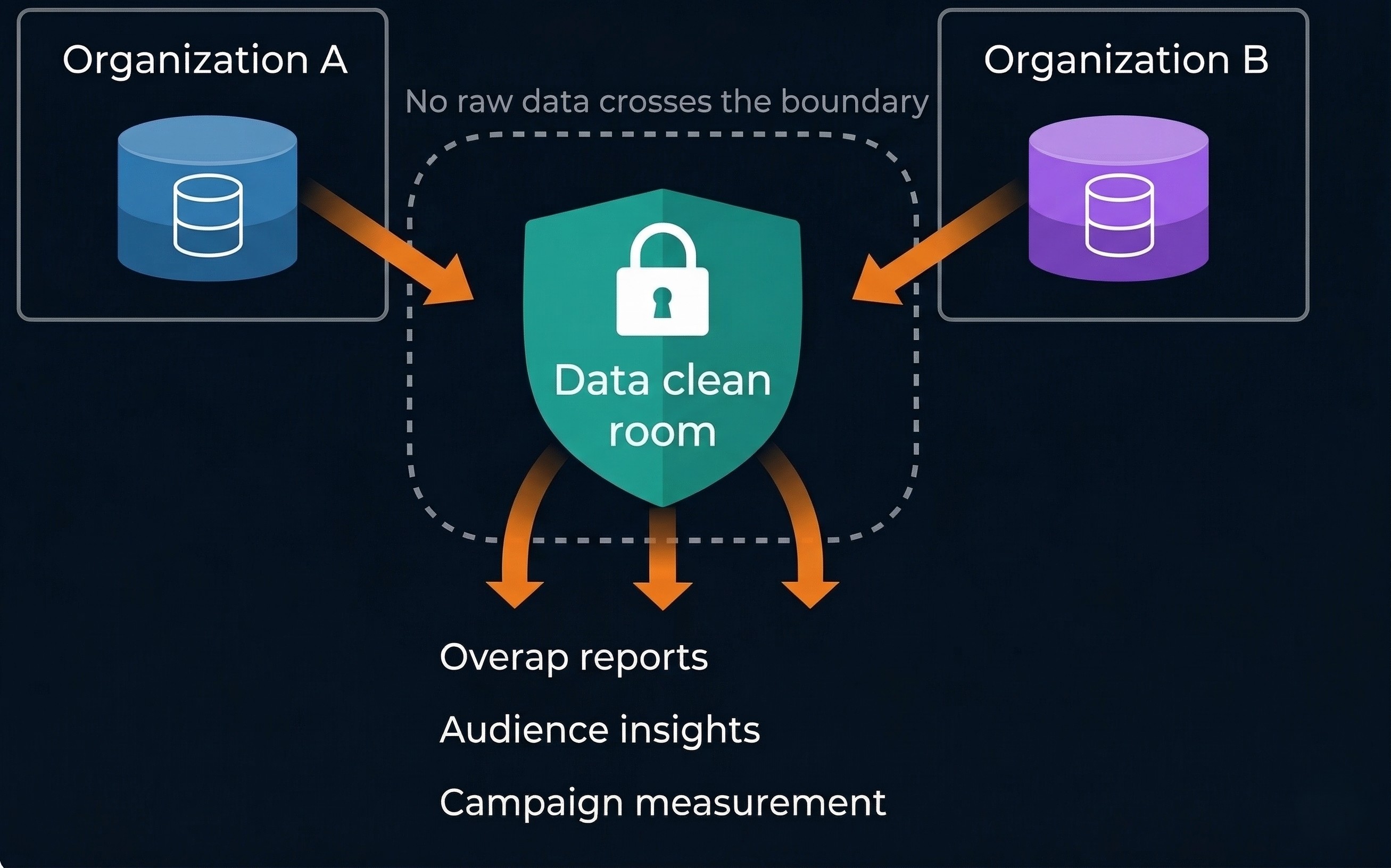
A data clean room is a secure environment where multiple organizations can match and analyze overlapping datasets without exposing personally identifiable information. Clean rooms are not a replacement for a CDP. They enable cross-party data collaboration rather than internal data unification. Find out more about what a data clean room is and how it works here.
Key players: AWS, Databricks, Decentriq, InfoSum, LiveRamp, and Snowflake.
What they solve: The collaboration problem. When two organizations want to understand audience overlap, measure campaign performance, or any other use case where multiple parties’ data needs matching or analysis, they need a neutral environment with controls beyond contractual trust. Clean rooms provide that with query restrictions and output limits.
How they differ from a CDP: A CDP is a single-party tool; a clean room is a multi-party tool. CDPs organize your own data. Clean rooms let you analyze data alongside a partner's without either party seeing raw records.
How they differ from a Collaborative Audience Platform (covered below): Most clean rooms stop short of audience building and activation. Building an audience in many traditional clean rooms and pushing it to an ad server or supply-side platform typically requires additional tooling.
Limitations:
- Insight-focused, not activation-focused. Many clean rooms produce analysis and overlap reports, not ready-to-deploy audience segments.
- Often requires technical expertise. Building queries, configuring permissions, and interpreting outputs typically needs a data scientist or engineer, unless a no-code interface is available.
- Each new partnership requires setup. Onboarding a new data collaboration partner can involve weeks of legal and technical configuration.
For a deeper look at how these two categories complement each other, explore why your martech stack needs both CDPs and data clean rooms.
Collaborative Audience Platform
A collaborative audience platform (CAP) is an emerging category. While DMPs traditionally handled audience building via cookies, the CAP replaces that broken model by allowing retailers and brands to build high-value audiences using secure, first-party identity matching. It bridges the gap between a CDP's audience logic and a Data Clean Room’s privacy-first architecture, enabling direct activation without the data ever leaving a secure environment.
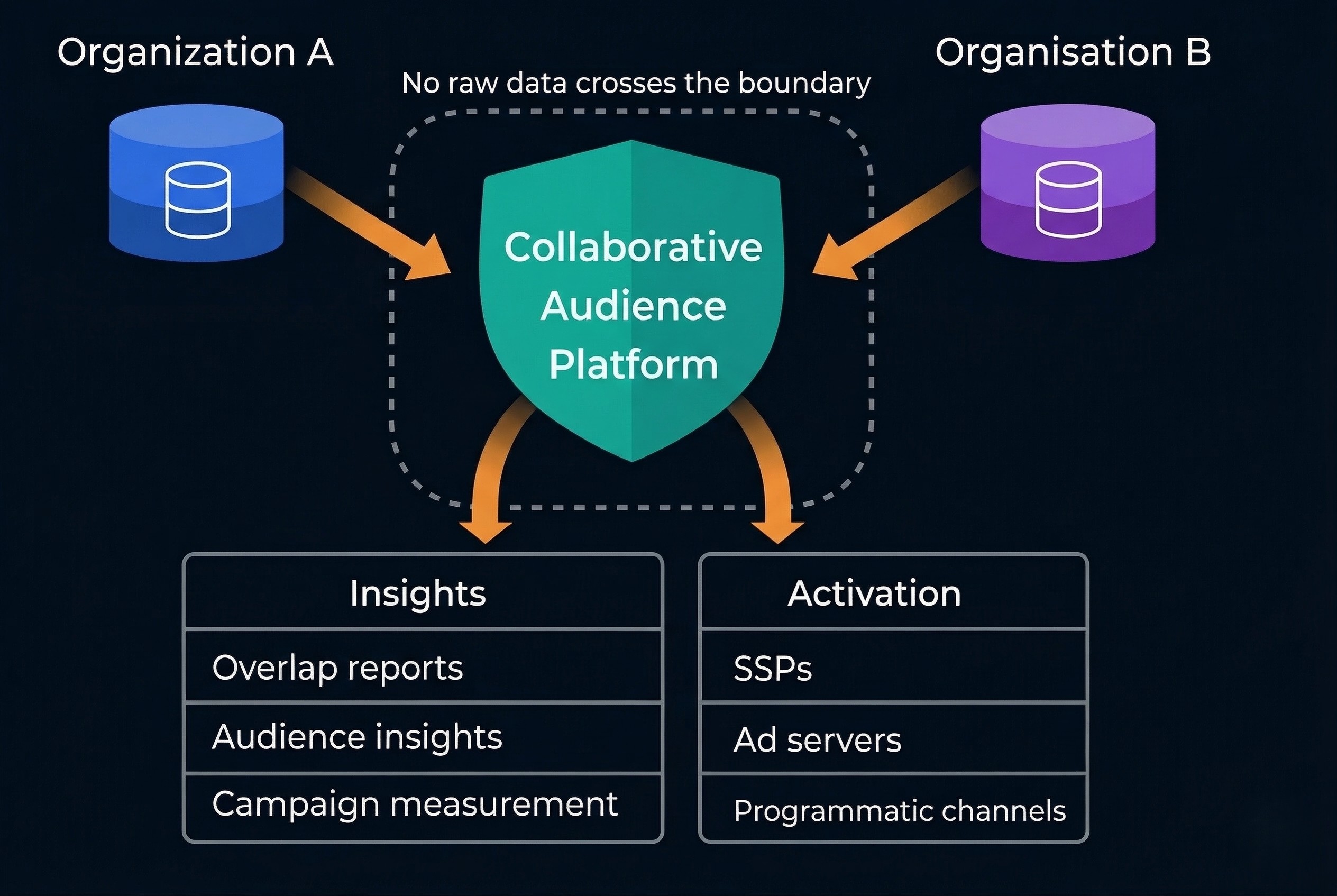
What it solves: Eliminates the legal and technical friction of manual exports, allowing users to instantly prove ROI through closed-loop attribution between ad views and actual sales. Essentially, it transforms CDP data into a high-yield media ecosystem. For retailers, it functions as a scalable retail media network; for publishers, it acts as a purpose-built Adtech CDP that allows them to monetize premium first-party data on the open web/CTV without the friction of a traditional, internal-only Martech stack.
How it differs from a CDP: A traditional customer data platform orchestrates internal first-party data. The Decentriq CAP is built for external collaboration: matching data across organizations and activating joint audiences directly.
How it differs from a data clean room: Clean rooms provide the secure environment. A CAP adds self-serve audience tools and direct media activation alongside it.
The platform is built on confidential computing, a hardware-level architecture that processes data inside isolated enclaves. Privacy is enforced at the infrastructure level, not through software controls or contractual agreements. No party, including Decentriq, can access the raw data in the collaboration. Read more here to understand how confidential computing enforces data privacy.
Best for: Advertisers, publishers, and retailers who need to collaborate on first-party data and activate audiences across programmatic channels. Key capabilities include:
- Pre-built partner network that reduces legal and technical overhead for new collaborations.
- Identity-neutral orchestration supporting universal IDs, hashed emails, and login-based signals without locking teams into a single framework.
- Direct integrations with major SSPs and ad servers for in-platform activation.
- Self-serve audience building and collaboration without requiring a data scientist for every campaign.
Limitations:
- Not designed for internal CDP use cases like CRM unification or single-customer-view reporting.
- Strongest in Europe. Teams in North America should evaluate partner network coverage.
For more details on how it all works, take a closer look at our Collaborative Audience Platform here.
How to choose: Composable CDP, clean room, or CAP
The right alternative depends on which problem is driving the search.
Three questions that sharpen the decision:
- Does the team have a cloud data warehouse with clean, well-modeled first-party data?
- Is the primary use case internal (own channels, own data) or external (partner data, publisher inventory)?
- How many data collaborations will the team run, and how fast do results need to go live?
Frequently asked questions about CDP alternatives
What is a collaborative audience platform?
A collaborative audience platform (CAP) combines the audience-building capabilities of a CDP with the privacy architecture of a data clean room and adds direct media activation. Instead of analysing overlapping data and then exporting results to a separate tool for campaign delivery, a CAP handles matching, enrichment, and activation in a single workflow.
The category is designed for advertisers, publishers, and retailers who need to collaborate on first-party data without exposing raw records. Decentriq is currently the primary dedicated platform in this space, with Permutive offering a similar “predictive Data Collaboration Platform”. Compare Decentriq and Permutive’s offerings, or learn more about our Collaborative Audience Platform here.
Are customer data platforms outdated?
Not inherently. CDPs remain the right tool for unifying internal first-party data across CRM, web, app, and offline touchpoints.
What has changed is the landscape around them. The decline of third-party data has created collaboration and activation needs that CDPs were never built to address. For teams whose primary gap is external, a CDP may be necessary but no longer sufficient.
What is the difference between a CDP and a DMP?
A customer data platform (CDP) collects and unifies first-party data to build persistent customer profiles based on known identifiers like emails or IDs. Similarly, a data management platform (DMP) is primarily used to organize an organization's own first-party data for advertising. However, the DMP model relies on third-party cookie syncing to match that data with the outside world. As these cookies have eroded, the DMP's ability to activate that first-party data has declined, leading teams to move toward CDPs and data clean rooms for secure, direct identity matching.
What is the difference between a CDP and a CRM?
A CRM stores known customer records and manages direct interactions like sales, support, and account history. A customer data platform ingests a wider range of sources: pseudonymous web behavior, app activity, and offline events. It unifies them into audience-level profiles for segmentation and activation.
What is the best CDP alternative for publishers?
Publishers typically want to monetize first-party audience data through collaboration with advertisers. The core requirement is working with partner data without exposing raw records. Learn how cookieless advertising is reshaping the approach.
A collaborative audience platform is purpose-built for this. It provides the secure matching, audience enrichment, and direct activation publishers need while maintaining full control over their data.
The CDP stack is changing. The question is where your gap sits.
As first-party data ecosystems mature, the distinction between these categories will sharpen. Diagnosing your gaps correctly now will help you to build a stack that will scale with the shift toward privacy-preserving collaboration rather than having to scramble to retrofit it later.
See how the Collaborative Audience Platform closes the gap between your CDP and your activation goals, or request a demo to see it in action.
References
Request a live demo
Want to see what else data clean rooms can do? Have a specific use case in mind? Let us show you.
Related content

Subscribe to Decentriq
Stay connected with Decentriq. Receive email notifications about industry news and product updates.