
Why GDPR stalls European data clean room partnerships and what can be done about it

Request a live demo
Want to see what else data clean rooms can do? Have a specific use case in mind? Let us show you.

Key takeaways
- The compliance bottleneck: European data partnerships frequently stall because traditional clean rooms rely on software controls and contracts, triggering complex joint controllership risks under the GDPR.
- The technical solution: Privacy-preserving data clean rooms use confidential computing to isolate data at the hardware level.
- The strategic payoff: Because data is processed in an operator-blind environment, no party can view raw records. This satisfies European privacy requirements by design and compresses legal review times from months to days.
Read the full analysis below to see how Decentriq operationalizes this zero-access architecture for brands, retailers, and publishers.
Ask anyone running a data collaboration partnership in Europe about the actual workflows. Typically, the commercial case comes together quickly: For example, a retailer with rich loyalty data, a CPG brand with campaign budgets to spend, a publisher with authenticated audiences.
On paper, they should be collaborating constantly. The data exists. The intent exists. The commercial incentive is obvious on all sides.
What kills most of these projects, though, is the moment the legal and compliance teams get involved.
Across European markets, data partnerships routinely spend six months or more in review before a single audience segment is matched. The holdups include, but are not limited to:
- Joint controllership negotiations
- Data processing agreement redlines
- DPO signoff queues
And by the time the paperwork clears, the campaign window has closed, the media plan has moved on, and everyone agrees to try again next quarter.
This is not a new problem. But two significant rulings in 2025 have sharpened its urgency considerably.
The 2025 legal catalysts: Russmedia and SRB
1. The Russmedia judgment (expanding joint controllership)
In December 2025, the Court of Justice of the European Union delivered its Russmedia judgment (C-492/23), expanding the conditions under which parties in ad technology relationships can be found to be joint controllers under GDPR.
The ruling confirmed that joint controllership does not require equal decision-making power or direct access to the data; it is sufficient for a party to exert converging influence over how data is processed. For publishers and platforms operating ad technology, this meaningfully expands the compliance surface area of any data partnership.
2. The EDPS v. SRB ruling (relative identifiability)
Separately, in September 2025, the CJEU issued its EDPS v. SRB ruling (C-413/23), clarifying when pseudonymized data qualifies as personal data under GDPR. The court established a relative, context-dependent test: pseudonymized data is not automatically personal data for every party in a collaboration.
Whether it qualifies depends on whether the recipient has the means reasonably likely to be used to re-identify individuals. As discussed below, this creates a meaningful legal advantage for platforms that make re-identification technically impossible rather than merely contractually restricted.
The structural answer to both challenges is the same, and it has been available longer than most legal teams realize.
The compliance friction matrix
Understanding why European data partnerships stall requires understanding why each party pumps the brakes, because the concerns are different, even if the outcome is the same.
- Brands: Brands are most concerned about inheriting regulatory liability they did not create. Under GDPR Article 26, when two or more organizations jointly determine the purposes and means of processing personal data, they become joint controllers, and are jointly and severally liable for the entire processing operation.
This means if a retail partner's consent collection turns out to be non-compliant, the brand that collaborated on that data activation can be held equally responsible, even if its own practices are entirely clean.
- Retailers and publishers: These parties are afraid of losing their core data asset entirely. Their first-party data (loyalty program records, authenticated reader graphs, purchase history) represents years of investment and a significant competitive moat. Any arrangement that requires sharing it with a brand partner, even for a bounded campaign, creates surface area for leakage, repurposing, or unauthorized access.
The December 2025 Russmedia ruling has added another layer of concern for publishers specifically: even passive involvement in ad technology processing can now be interpreted as establishing controllership, which means the legal exposure from a poorly configured clean room partnership is no longer theoretical.
- Agencies: The biggest issue here is friction and timeline pressure. Agencies are responsible for campaign delivery, but they have no direct control over the legal review timelines that determine when data collaboration can actually begin. So when a six-month negotiation compresses a twelve-month plan into five months of execution, the agency carries the pressure while having none of the leverage.
What all three parties share is that the underlying compliance challenge is not about bad actors or bad intentions. Everyone at the table wants to run a legal, privacy-safe collaboration. The problem is that traditional clean room approaches require too much trust between the parties. Trust, under strict European privacy law, is not a legal basis for processing.
Zero-access architecture: Compliance by construction
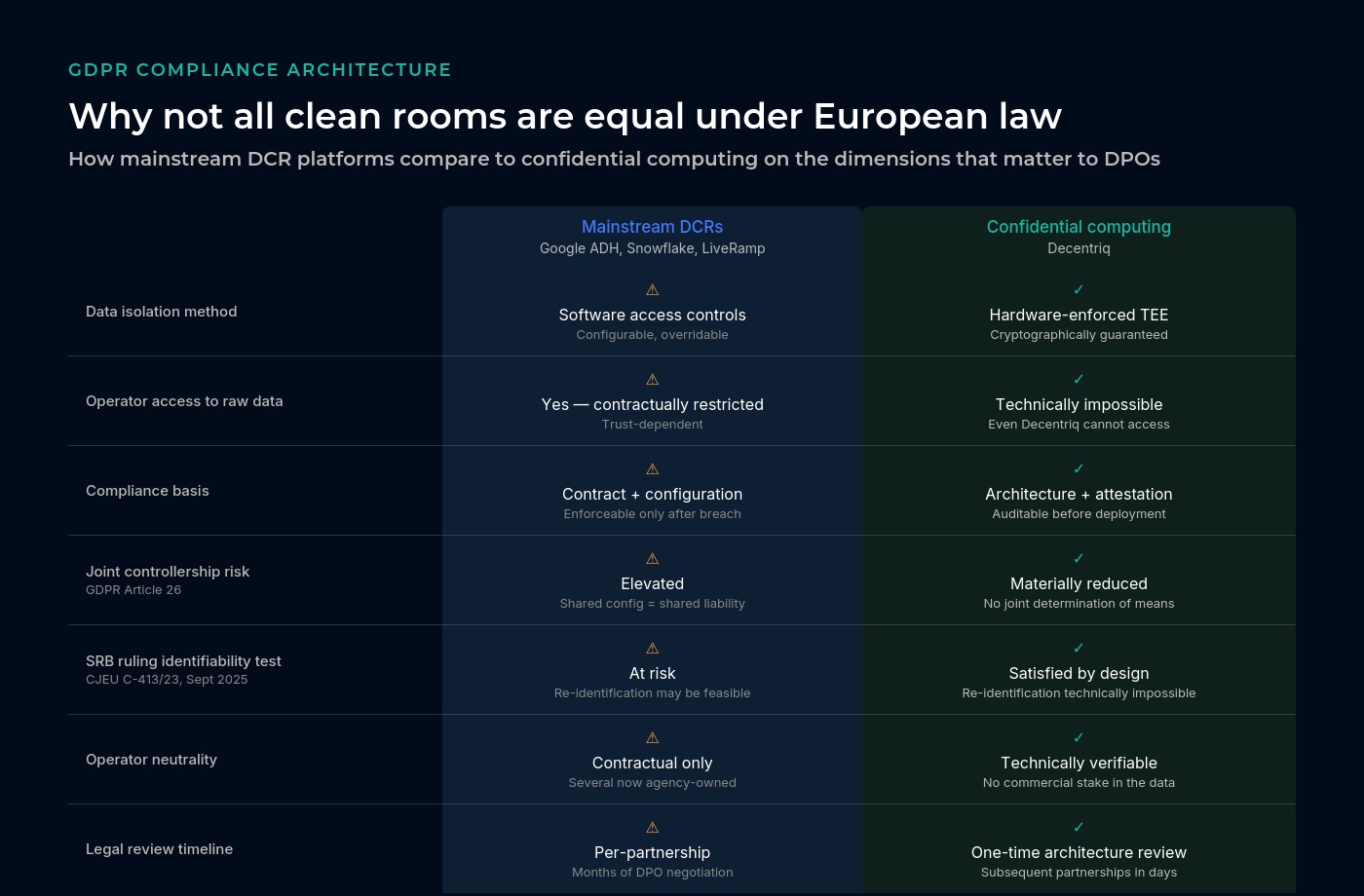
Most major clean room providers (Google ADH, Amazon AMC, Snowflake, LiveRamp) frame their platforms as GDPR-compatible, and in a narrow technical sense, they are. They implement access controls, offer contractual agreements, and restrict raw data from crossing lines. For straightforward use cases in permissive environments, this is often sufficient.
The problem lies in the underlying compliance model:
- Software configuration vulnerabilities: Access controls can be misconfigured, updated, or overridden.
- Post-facto enforcement: Effective enforcement of contractual obligations to prevent a violation is difficult.
- Platform operator access: In most cases, the infrastructure host has technical access to the data flowing through it. Collaborator DPOs are essentially asked to blindly trust the configuration and the operator's long-term neutrality.
The conflict of centralized clean rooms
Several of the largest clean room providers are also active participants in the data ecosystem they operate. Google ADH runs inside Google's infrastructure; Amazon AMC runs inside Amazon's. The entity administering the clean room has a direct commercial interest in the audience data moving through it.
For a European retailer or publisher, this conflict is real, even if contractually managed.
How confidential computing changes the paradigm
Confidential computing takes a structurally different approach. Rather than relying on access controls and contractual commitments, it enforces data isolation at the hardware level using Trusted Execution Environments (TEEs): secure enclaves built into the processor itself.
Data brought into the enclave cannot be accessed by any external party, including the platform operator. The matching and analytics run inside the chip. At no point does any party gain access to another party's raw data, because the architecture makes that access technically impossible rather than contractually prohibited.
.jpg)
Shifting from "trust" to "verification"
For DPOs, TEEs change the nature of the review entirely. Instead of asking "How do we trust this configuration?" the question becomes "Can we verify that this architecture holds?" And because the guarantees are cryptographic and hardware-enforced, they can be independently audited.
When neither party has the ability to identify the data subjects in the other party's data, the joint determination of the purposes and means of the processing of personal data that triggers joint controllership simply does not arise in the same way.
An important clarification on consent
Architecture does not replace consent. The clean room only addresses what happens to data inside the collaboration environment. The upstream obligation of ensuring users have consented to data usage on a valid lawful basis remains with the data owner.
What confidential computing removes is the downstream compliance risk that follows from collaboration itself. Brands are no longer exposed to a partner's consent failures, and retailers/publishers do not risk their core data assets.
The September 2025 SRB ruling reinforces this directly: under the court's relative identifiability test, a recipient who cannot realistically re-identify individuals is not subject to the same GDPR obligations as the original controller. A confidential computing architecture, where collaborating parties receive only aggregated outputs and have no technical path to the underlying data, is precisely the kind of arrangement the court's reasoning rewards.
What the ecosystem gains when legal friction is removed
The commercial case for data clean rooms has always been well understood. The problem has been that the legal costs of reaching that commercial value were high to absorb. Remove the legal friction and the value proposition for each party in the ecosystem becomes straightforward. The following subsections outline what this means for each player in a media/advertising collaboration:
Retailers and publishers
Confidential computing-based clean rooms make first-party data monetization genuinely scalable. A retailer that previously ran one or two carefully negotiated brand partnerships per year can open its data asset to multiple concurrent collaborations without multiplying its compliance overhead. The retailer retains full control, while audience matching, campaign measurement, and closed-loop attribution all happen without the raw data ever being accessible to the brand partner.
This also applies to publisher alliance clean rooms, where multiple publishers pool their authenticated audiences to offer the kind of scale that competes with walled-garden inventory. Deploying this architecture through Decentriq, Laboratoires Pierre Fabre's multi-publisher collaboration is a practical example: the brand matched customer IDs across three publishers simultaneously, with none of the publishers ever accessing each other's data or the brand's raw records.
Brands
Closed-loop measurement across retail media networks, premium publisher audiences, and multi-partner collaborations becomes available without the compliance exposure that has made it prohibitively slow.
Brands can activate against high-quality first-party data at the targeting and measurement precision the channel demands, without accepting joint and several liability for a partner's data governance practices. Samsung's cross-publisher campaign with Publicis Media and United Internet Media demonstrates this at scale using Decentriq’s clean rooms: automated daily matching of first-party CRM segments across multiple publishers, with full GDPR compliance and no dependency on third-party cookies.
Agencies
The most immediate benefit is time-to-campaign compression. Legal review of a well-documented confidential computing architecture becomes a one-time assessment rather than a per-campaign or per-partnership negotiation.
Once a client has cleared the architecture review, subsequent partnerships on the same infrastructure run on a much shorter timeline. A collaboration that previously took six months to clear compliance can move in days.
Verifiable neutrality in a consolidated market
There is also a market structure argument worth making explicitly: Independent clean room platforms have been consolidating at a rapid rate over the past several years. In 2024 and 2025, several of the most widely used neutral platforms were acquired by agency holding companies or folded into walled-garden ecosystems.
For data owners evaluating clean room partnerships, this creates a legitimate concern: if the platform is owned by an agency or a competitor, can the neutrality guarantees actually be verified? With operator-blind confidential computing, the answer is yes.
Closing the gap between commercial intent and architecture
When data isolation is enforced at the hardware level, when the platform operator has no access to raw data, and when the audit trail is cryptographic rather than contractual, the review process has something solid to verify rather than something to negotiate around.
The regulatory landscape will keep moving. The legal rulings made in 2025 will continue to create new compliance surface area for partnerships built on access controls and contractual trust alone.
Building on an architecture designed for the stricter interpretation, one where the technical guarantees make legal arguments redundant, is the durable choice.
Data collaboration in Europe frequently stalls due to a mismatch between traditional infrastructure and the strict regional legal environment. With data clean rooms built natively on confidential computing, Decentriq resolves this fundamental friction. This technical framework allows brands, retailers, agencies, and publishers to bypass prolonged liability negotiations and focus directly on launching campaigns.
Get in touch to find out more about how Decentriq's data clean rooms allow you to collaborate with full GDPR compliance.
References
Request a live demo
Want to see what else data clean rooms can do? Have a specific use case in mind? Let us show you.
Related content




Subscribe to Decentriq
Stay connected with Decentriq. Receive email notifications about industry news and product updates.