

Request a live demo
Want to see what else data clean rooms can do? Have a specific use case in mind? Let us show you.

Measurement means different things to different teams. Some define it as last-click attribution, some as media mix modeling, some as whatever a walled garden dashboard reports back. Much of this variation comes down to data access rather than definitions.
Most measurement approaches were built at a time when advertisers, platforms, and publishers could share user-level data with each other more freely. That has changed. Third-party cookies are inconsistently available across major browsers, Apple's App Tracking Transparency framework has reduced mobile signal, and GDPR and CCPA require consent that a meaningful share of users decline. Walled gardens add another layer of separation: Google, Meta, and Amazon report on activity within their own platforms but do not share individual-level data outside them.
The result is a fragmented picture. Brands assemble a partial view from platform-reported metrics, in-house modeling, and whatever an agency partner can reconstruct after the fact, but these pieces rarely reconcile cleanly with one another.
Data clean rooms address this by letting two or more parties measure media impact jointly, without exposing raw data to each other (though the technical guarantees behind that vary by provider). The sections below cover how that works in practice, along with where different approaches to clean rooms diverge.
Why modeling alone has limits
Much of the industry's response to signal loss has been to model around it: estimate what can't be directly observed, aggregate what can't be tracked at the individual level, and work with a wider margin of error. Media mix modeling has improved considerably under this pressure, as has cookieless attribution, which works from aggregate delivery data rather than individual identifiers.
These approaches are useful for directional insight, but they are less reliable for answering a more specific question: whether a particular campaign drove a particular outcome for a particular audience, especially when that audience spans more than one platform or more than one company's data.
Answering that question with precision generally requires two parties to join their data at the record level, rather than approximate a result statistically. Historically, that meant one party sending the other a spreadsheet or data feed and relying on trust that the data would not be retained or exposed further. For regulated market categories like healthcare or finance marketing, this was rarely a workable path. For other categories, it became a growing source of legal and reputational risk as privacy regulation tightened.
How a data clean room works for measurement use cases
A data clean room is a secure computing environment where multiple parties bring their own data, run a joint computation, and each receive only the output they are entitled to see, without either party gaining direct access to the other's raw data.
The mechanisms used to enforce this vary across the market. Some clean rooms are SQL-based environments operated by a neutral third party or the platform itself. Privacy is enforced through contractual controls, hashed or tokenized identifiers, and output restrictions like minimum cohort thresholds or differential privacy, rather than through technical isolation of the data. In these setups, the operator typically retains some level of technical access to the underlying data, even if usage is limited by policy and audit.
In practice, this range of approaches allows a media platform to report how many impressions reached a brand's actual customers, and a brand to report how many of an exposed audience converted, without either party seeing the other's individual-level records in the output.
Where clean room platforms differ
Arguably the most important factor is whether the party running the measurement has any stake in the outcome being measured.
A clean room operated by the same platform selling the media it measures faces an inherent conflict: it is, in effect, grading its own homework. This is the core limitation of walled garden reporting, as described above.
The same question extends to independent clean room vendors once they are owned by a company with its own media-buying interests. InfoSum was acquired by WPP in April 2025 and now operates within GroupM, WPP's media investment arm. LiveRamp has agreed to be acquired by Publicis Groupe, a deal announced in May 2026 and expected to close by the end of the year. In both cases, a company built on a promise of neutral data collaboration now sits inside, or will soon sit inside, an organization that also buys and manages media on behalf of clients. That raises the same structural question walled gardens face: can a platform's measurement of a campaign be trusted as independent when the platform itself belongs to an entity with a direct interest in how that campaign's performance looks?
Decentriq is independent: not owned by an agency holding company, a media platform, or any party with a stake in the campaigns it might be used to measure.
Beyond ownership, there is a second, technical dimension worth noting: whether the operator or platform itself retains any access to raw data, or whether that access is removed entirely through the underlying architecture. Decentriq's approach addresses both.
Confidential and operator access
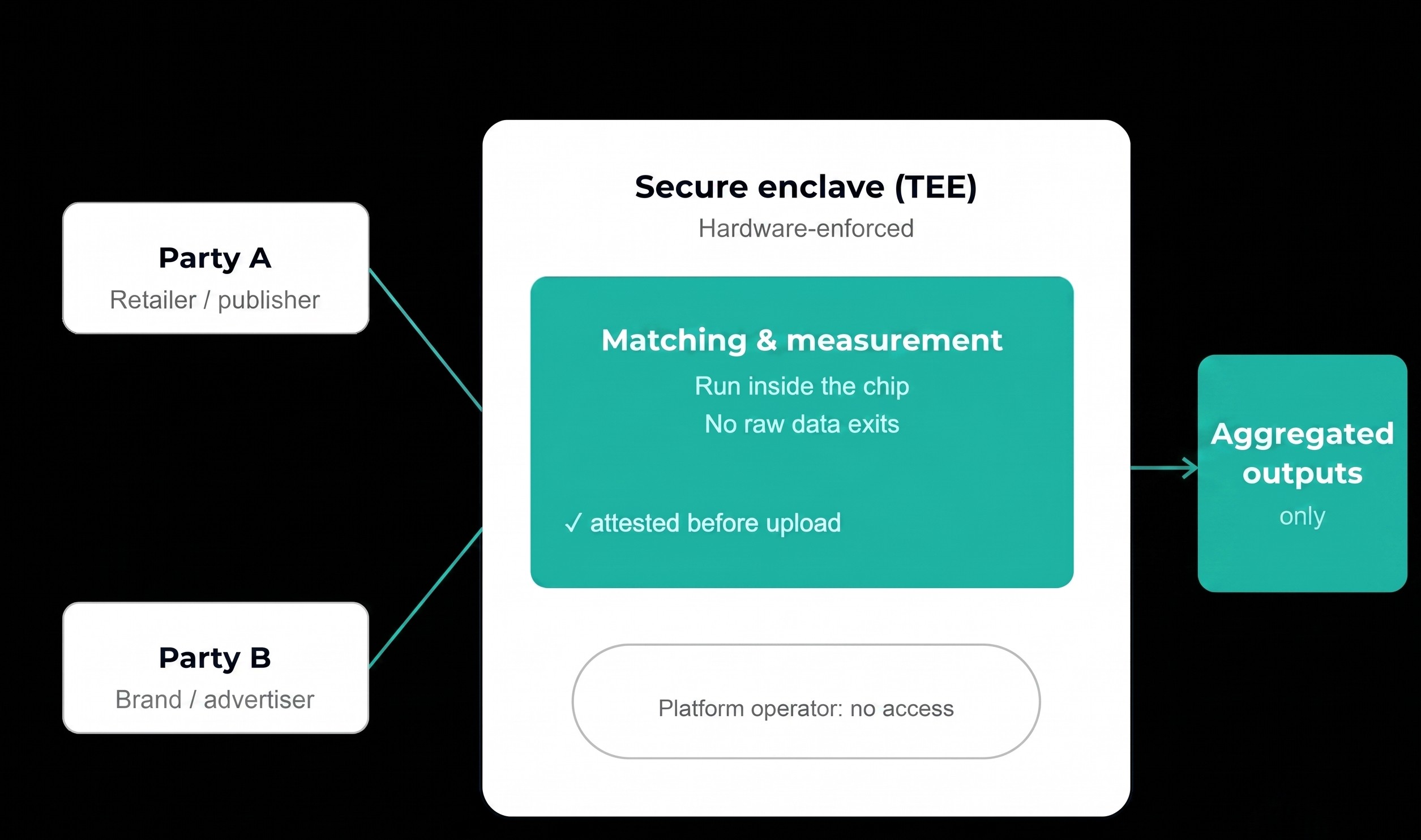
Decentriq's clean room runs on confidential computing: data is processed inside a trusted execution environment that is isolated even from Decentriq's own infrastructure. Data enters encrypted, the computation runs inside that isolated space, such as matching two customer lists or running an incrementality analysis, and only the agreed, aggregated output is returned.
Query design plays a role here too. Minimum cohort thresholds and query auditing are used to prevent a party from reconstructing individual records by repeating similar queries with small variations. This is a stronger technical guarantee than contractual or policy-based controls alone, since it does not depend on trusting an operator to behave correctly.
Clean room-native measurement
Analysis, including incrementality and lift measurement, runs inside the confidential computing environment itself. The result connects back to the media partners already running the campaign, rather than being routed into a separate report.
Attribution methods currently supported in-platform include sales lift and incremental reach. Audience verification runs as a separate capability alongside these.
What this looks like in practice
The following examples are anonymized and illustrate specific measurement methodologies in more detail.
Incremental reach
A streaming publisher matched exposure data against a linear TV panel provider to measure the unique audience that CTV advertising reached beyond traditional linear TV. The result showed an incremental reach index of 1.4 against a baseline of 100, with 76% of the publisher's viewers not otherwise reached through linear TV.
Attribution
An advertiser matched conversion events against exposure data from a social media platform using hashed emails. This matching approach is available on Meta today, with availability on other platforms such as TikTok, Snapchat, Reddit, and LinkedIn depending on the specific business case.
Conversion lift
By matching exposed and non exposed users to sales events, an advertiser measured sales lift by creative across two products. Results ranged from a 2% lift for one creative to a 33% lift for another, depending on the product and creative combination. Results informed smarter or optimized targeting on the ad platform.
Frequently asked questions
Why is walled garden reporting not sufficient on its own?
Google, Meta, and Amazon each report on their own platform using their own methodology, without an independent way to verify those figures against what actually happened. A clean room allows a brand to join its own conversion data directly against a partner's exposure data, producing a result both sides computed together rather than one platform reporting on itself.
What does a team need in place before this works?
A usable first-party dataset such as a CRM export of recent purchases or subscriptions. Teams without that foundation typically need to establish it first, regardless of which vendor operates the clean room.
How does this differ from running the same process through LiveRamp or InfoSum?
Ownership is the clearest point of difference. InfoSum is now owned by WPP and operates within GroupM, WPP's media investment arm. LiveRamp has agreed to be acquired by Publicis Groupe, in a deal announced in May 2026 and expected to close by the end of the year. Both were built on a pitch of neutral data collaboration, and both now sit inside, or will soon sit inside, an agency holding company with its own media-buying interests, which raises the same independence question that applies to walled garden reporting.
On the technical side, LiveRamp's clean room has historically resolved matching through RampID, its own identity graph built from offline PII matched across a large network of contributed data. Since acquiring Habu in 2024, LiveRamp also supports matching on different identifiers such as hashed emails, so identity graph dependency is no longer the full picture. InfoSum takes a different architectural approach again, keeping each party's data within its own environment and running computation in a federated way rather than inside a shared encrypted enclave.
Does this require a data science team, or can marketing operate it directly?
For common use cases like conversion lift measurement, Decentriq provides out-of-the-box templates that let publishers, retailers, and advertisers combine exposure and conversion data directly, without writing custom queries or requiring a data science team to build the analysis from scratch.
See it in practice
Get in touch to find out how to use data clean rooms for your use case.
References
Request a live demo
Want to see what else data clean rooms can do? Have a specific use case in mind? Let us show you.
Related content



Subscribe to Decentriq
Stay connected with Decentriq. Receive email notifications about industry news and product updates.